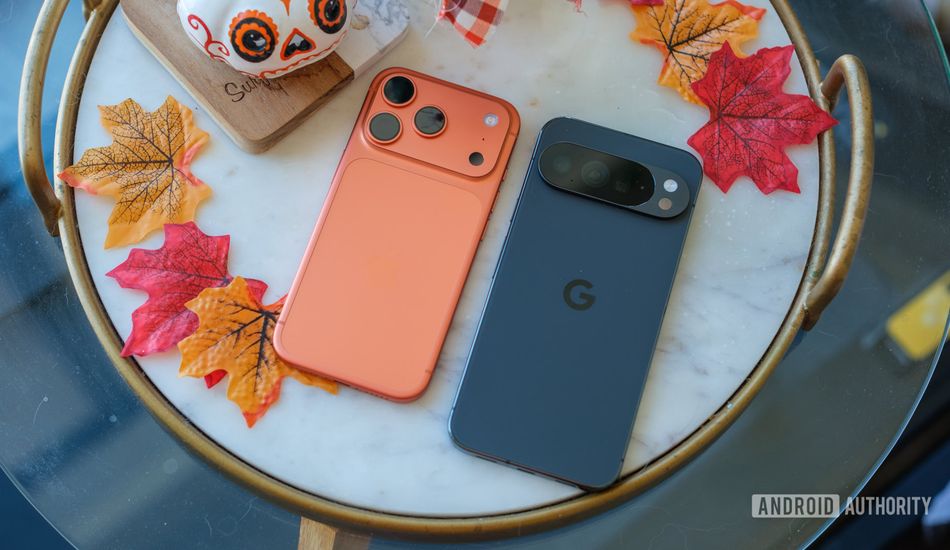
Android and iOS Harmony: Breaking Down the Mobile Ecosystem Walls
I'm genuinely excited about the recent developments bridging the gap between Android and iOS. The introduction of RCS on iPhones and Google's efforts to make AirDrop compatible have significantly lowered the barriers between these two ecosystems. It's a huge accomplishment by Google, ensuring AirDrop seamlessly integrates with Quick Share on Pixel phones without compromising security. This means I won't feel excluded when iPhone users share content via AirDrop at events just because I use a Pixel.
Although this is a great start, there's more Google can do to create a smoother experience for both Android and iPhone users, tackling the ecosystem divide one step at a time.
Data Migration Nightmares
Switching between Android and iPhone is often daunting. You never know what data will successfully transfer. Although both Google and Apple offer apps to assist with data migration, the experience can be far from ideal. For me, WhatsApp has always been the biggest pain point, particularly when dealing with multiple accounts. While contacts, messages, photos, and calendar entries usually transfer without issue, Google could streamline the process by including app libraries in the transfer. Additionally, while eSIM transfers are possible across platforms, they aren't as seamless as when moving between two iPhones or two Android phones. The fragmentation within Android, where eSIM transfers differ from brand to brand, only adds to the complexity.
When it comes to smart home devices, Matter was supposed to be the answer, but it's not. Although both Google and Apple are working on this protocol to ensure smart home accessories work seamlessly with both Siri and Gemini, availability is a major issue. Finding Matter-compatible hardware requires effort, as it's not yet mainstream.
Wearable incompatibility is another significant problem. While older Galaxy smartwatches used to work with iPhones to some extent, that's no longer the case. Predictably, Apple smartwatches only pair with iPhones. Even when you manage to connect Apple accessories like AirPods to an Android device, the experience is so limited that you question the value of the purchase. It will be awesome if Google did something about this!
Families often have members with different tech preferences – a Mac user with an Android phone, iPhone users in a Google Home-equipped house, or an Android user with an iPhone-toting partner. Since family sharing isn't platform-agnostic, you either miss out on cross-platform features or settle for a subpar experience. While sharing subscriptions like Apple Music and YouTube is easy, sharing locations requires relying on third-party tools like WhatsApp. And the thought of pairing a Pixel Watch with an iPhone or an Apple Watch with Android is almost comical.
While Apple has enabled setting up Apple Watches using another person's iPhone for kids or parents with Android phones, it's still not the same as full compatibility.
AirTags, while having many alternatives, stand out due to their precision tracking using UWB (Ultra-Wideband) technology, which I love. AirTags do work with Android for scanning lost items or detecting unwanted trackers, but that's where the interoperability ends. In mixed Android and iPhone households, using AirTags becomes cumbersome, as you can't set up or locate them on an Android phone. Even though modern Pixels and many Android phones have UWB, they can't use precision tracking with AirTags. A universal item-tracker protocol, similar to Matter, would benefit users, but it might weaken Apple's ecosystem grip, which could be why it doesn't exist yet.
Switching to an iPhone, I would miss tap-and-pay with Google Wallet. It's my go-to payment method, and without it, my phone feels incomplete. What's worse is that Apple Pay isn't available in my region. If Android allows NFC payments through third-party apps, Apple should have no reason to restrict it to its own payment app, other than for profit.
The Android vs. iPhone debate is old news. Both platforms are neck and neck, each with its own strengths. It really boils down to personal preference.
Given this reality, it's essential for both platforms to work together. Forcing Apple through EU regulations isn't the answer; it only harms users in those regions with missing features. I hope Google and Apple can cooperate to ensure their products and services are interoperable.
However, Google's success in achieving AirDrop parity without Apple's help gives me hope. Until Apple blocks this workaround, it's a victory for everyone. I hope Google continues to deliver more of these wins.
Source: AndroidAuthority